
Managing a school has become more complex than ever.
Today, schools need to manage admissions, attendance, fees, academics, student records, communication, and many other daily tasks. Parents want quick updates, teachers need simple tools, and school management needs a clear view of everything.
Still, many schools depend on paper files, Excel spreadsheets, WhatsApp, separate software, and manual processes. Managing everything through disconnected systems can be time-consuming and difficult to track.
So, how can schools manage all these operations more efficiently?
Let’s explore how School ERP Software can bring different school functions together on one platform and make school management simpler, faster, and more organized.
What Is School ERP Software?
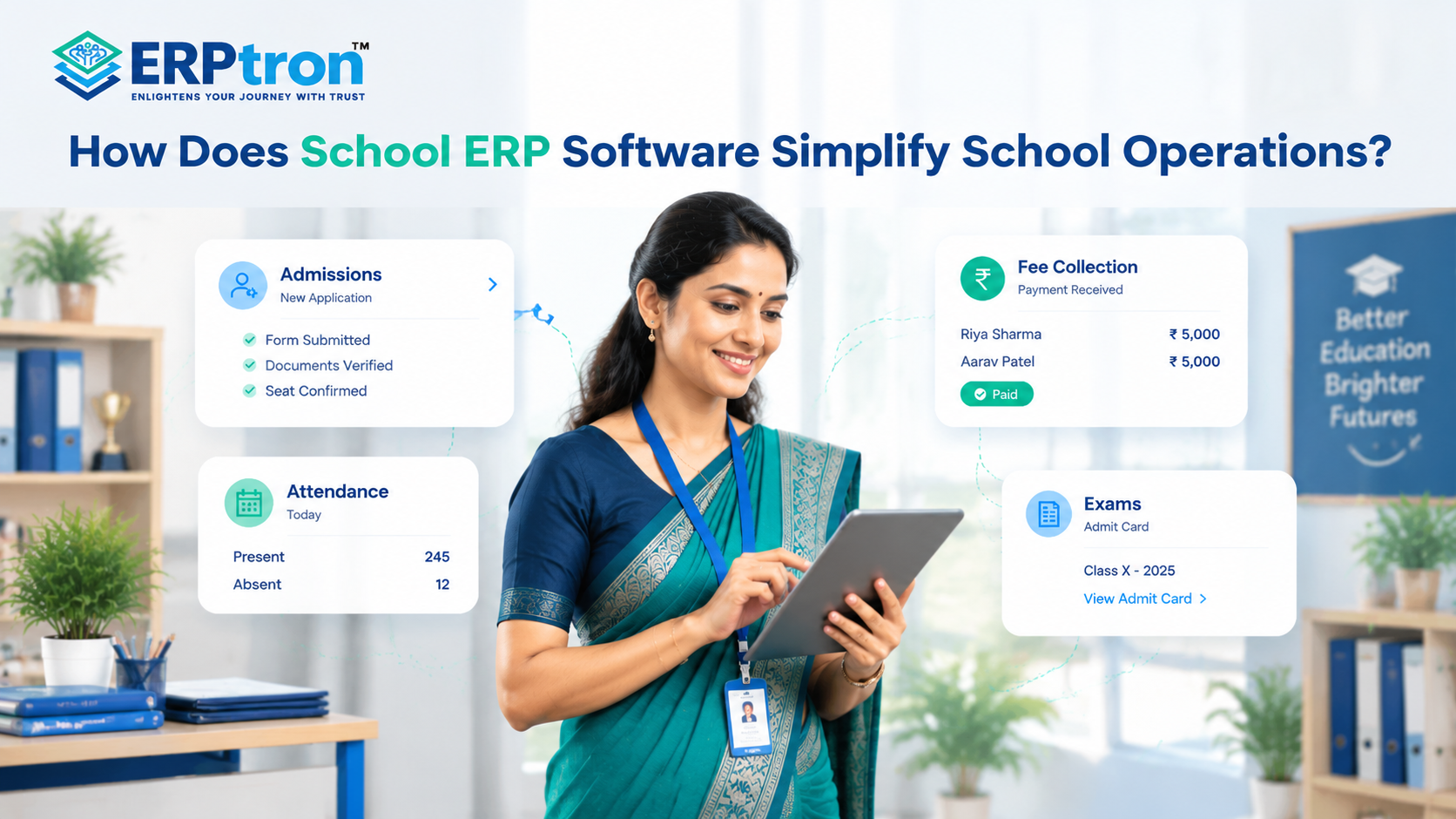
School ERP Software is a digital platform that helps schools manage their academic, administrative, financial, and daily activities in one place. Instead of using different tools for different departments, a School ERP brings important school processes together on one platform.
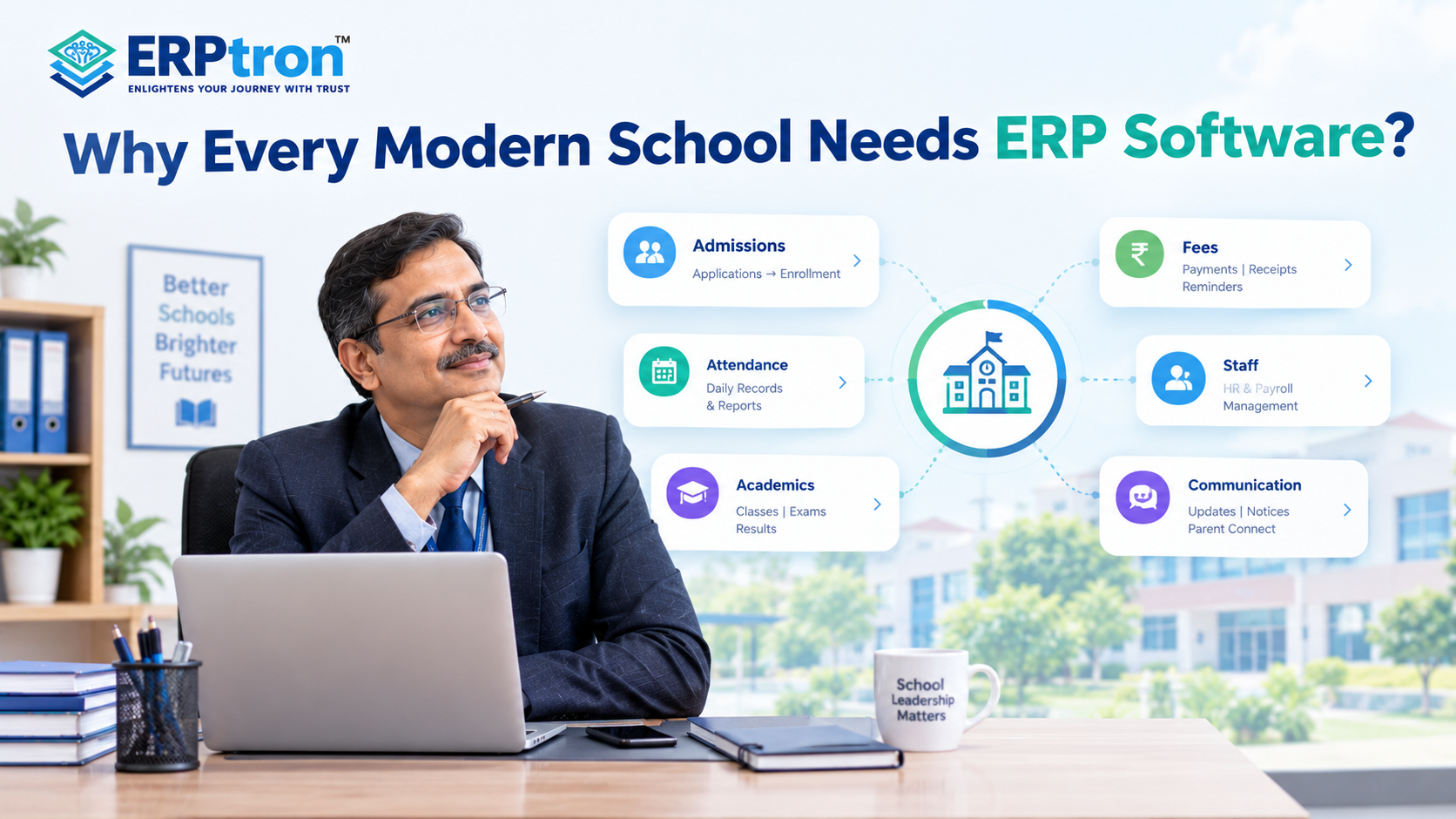
A typical School ERP may include admissions, student management, attendance, academics, examinations, fees, communication, and reports. Depending on the software, it may also include HR and payroll, transport, library, hostel management, CRM, LMS, mobile apps, and analytics.
For a broader understanding of how these functions support school operations, explore this complete guide to school administration software.
Why Is Traditional School Management Becoming Difficult?
Traditional school management can work well when a school is small. Schools have been using registers, files, Excel sheets, and manual processes for years.
But as a school grows, managing everything manually becomes harder.
A school with 100 students may be able to manage attendance, fees, student records, examinations, and communication without much difficulty. But when the school grows to 500, 1,000, or 2,000+ students, the amount of work increases.
Schools have to manage more student records, attendance, fee payments, teachers, classes, parents, admissions, examinations, communication, and reports.
The bigger challenge is that these activities are connected.
For example, when a new student joins the school, their information may be needed for attendance, academics, examinations, fees, communication, and reports. If each department keeps separate records, staff may have to enter the same information again and again.
The Problem With Disconnected School Systems
Many schools use different tools for different tasks.
- Excel → Student Data
- Paper Registers → Attendance
- Another Tool → Fees
- WhatsApp → Communication
- Forms → Admissions
- Manual Files → Examinations
Each tool may work well on its own. But when these tools are not connected, staff have to move information from one place to another.
This can lead to:
- Duplicate data entry
- Repeated work
- Incorrect or outdated information
- Difficult reporting
- More manual follow-ups
- More time spent on administrative work
For example, when a new student is admitted, their details may need to be entered into several files or systems. If the information changes later, staff may need to update it in multiple places.
A School ERP brings these processes together:
One Platform → Shared Data → Connected Processes → Better Management
The goal is not just to replace paper with digital tools. The goal is to reduce manual work, connect different school activities, and make school management easier.
15 Reasons Every Modern School Should Consider ERP Software
Managing a school with paper files, spreadsheets, and multiple tools can become difficult as the school grows. A School ERP can bring important school activities together, reduce manual work, and make daily management easier.
Let’s look at the reasons why modern schools should consider ERP software.
1. Centralize School Information
A School ERP stores student details, parent information, attendance, fees, admissions, and exam results in one place. This helps staff find information quickly, maintain organized records, and reduce repeated work.
A Student Information System (SIS) can further help schools maintain and access important student records through a centralized digital system.
2. Reduce Administrative Work
A School ERP simplifies routine tasks such as updating records, preparing fee receipts, generating reports, and sending reminders. This saves time and allows staff to focus more on students, parents, and important school activities.
3. Connect Different School Departments
A School ERP connects admissions, academics, attendance, examinations, fees, and parent communication through one system. This reduces duplicate data entry, improves coordination, and helps different departments work more efficiently.
Schools can compare available capabilities with this guide to essential School ERP features when deciding which functions they need.
4. Improve Student Data Management
A School ERP stores student details, parent contacts, attendance, academic records, and fee information in one place. It helps staff access and update records easily, saving time and keeping information organized. Schools can also use a Student Information System (SIS) to manage student records efficiently.
5. Make Attendance Management More Efficient
A School ERP simplifies attendance recording, tracking, and reporting. Depending on its features, it can also help schools monitor attendance history and send attendance updates to parents, reducing paperwork and saving teachers’ time.
Learn more about the student attendance management system and how digital attendance processes can support schools.
6. Simplify Fee Management
A School ERP helps schools manage fee structures, payments, receipts, pending dues, reminders, and collection reports. Some platforms also support online fee payments, making the process more convenient for parents and easier for school administrators to track.
A dedicated fee management system for schools can help institutions organize fee collection and maintain clearer payment records.
7. Make the Admission Process Easier
A School ERP helps manage the admission process, from student enquiries and applications to document verification and enrolment. Schools with CRM features can also track prospective students and follow up with parents more efficiently.
Schools can explore this complete guide to online admission management software to understand how digital admission workflows can simplify applications and follow-ups.
8. Improve Parent Communication
A School ERP helps schools share notices, attendance updates, fee reminders, exam schedules, and event information through portals, mobile apps, or notifications. This keeps parents informed and makes school communication more organized.
For more ideas, read about parent communication software for schools and how it can help schools share information more efficiently.
9. Give Teachers Better Digital Tools
A School ERP allows teachers to manage tasks such as attendance, timetables, examinations, and student records through a connected platform. Easy-to-use tools can reduce administrative work and give teachers more time to focus on teaching.
A well-designed teacher management system can also help schools organize staff information and simplify routine faculty administration.
10. Make Reporting Faster
A School ERP brings school data together to simplify reports on attendance, fees, admissions, examinations, and staff activities. This reduces the time spent collecting information manually and helps management access important reports more quickly.
11. Improve Decision-Making
A School ERP provides useful information about student performance, attendance trends, fee collection, and admissions. School administrators can use these reports to understand current performance, identify areas for improvement, and make informed decisions.
12. Improve Accountability and Transparency
Depending on its features, a School ERP can provide user permissions, activity logs, payment records, and admission status tracking. These tools help schools monitor important activities, clarify responsibilities, and manage information more transparently.
13. Give Parents a Better Experience
A School ERP can give parents convenient access to attendance records, fee details, exam results, notices, and academic updates through a portal or mobile app. This reduces the need for routine phone calls and school visits while improving access to information.
Schools can also explore how school mobile apps improve communication between parents, teachers, students, and school management.
14. Help Schools Grow
As schools expand, managing more students, staff, records, and activities becomes increasingly complex. A scalable School ERP helps maintain organized processes and supports future growth by accommodating additional users, students, campuses, and modules as needed.
15. Build a Future-Ready School
A School ERP helps schools adopt digital processes, connected data, online communication, and data-driven management. By choosing technology that addresses real operational needs, schools can improve efficiency and create a better experience for students, parents, teachers, and administrators.
Explore how technology in education is changing schools and creating new opportunities for more connected, efficient learning environments.
Conclusion
School ERP software can help modern schools simplify daily operations, improve coordination, reduce paperwork, and manage information more effectively. The right solution should be easy to use, secure, scalable, and suitable for the school’s needs.
ERPtron brings essential school management functions together through dedicated, connected modules, helping educational institutions move towards more organized and efficient digital management.
Why Is ERP More Than Just School Software?
A School ERP is more than just a tool for replacing paper records with digital records. Its real value comes from connecting different school activities and making everyday work easier.
For example, think about the admission process. In a traditional system, a student’s information may first be written on an admission form. Then, staff may enter the same information into an Excel sheet, student file, attendance register, and fee record. This means the same work is repeated several times.
With a connected School ERP, the process can be much simpler. When a student is admitted, the information can be added to the student’s digital profile and then used for related activities such as attendance, fees, academics, examinations, and communication.
This means staff do not have to manage every activity separately. They can work with connected information from one system. So, the real difference is not simply paper vs. computer. It is about moving from separate processes to connected processes.
What Happens If Schools Don’t Digitize?
Manual processes can work well for smaller schools. If there are fewer students and fewer daily activities, registers and spreadsheets may be enough.
However, things can become more difficult as the school grows. More students mean more records, more attendance data, more fee transactions, more admissions, and more communication with parents.
Staff may then spend a lot of time updating records, searching for information, preparing reports, and checking different files. Sometimes, the same information may also be entered in more than one place.
This can lead to more manual work, duplicate information, slower reporting, and difficulty in managing daily activities.
This does not mean every school must immediately stop using manual processes. The important question is whether the current system is still working well as the school grows.
If managing daily operations is becoming harder, a School ERP can help bring different activities together and reduce unnecessary manual work.
Does Every School Need a Full ERP?
Not every school needs every ERP module from the beginning.
Every school has different requirements. A small school may only need basic features such as student management, attendance, and fee management.
As the school grows, it may add other modules such as admission management, examination management, communication, HR, payroll, transport, library, or LMS.
This allows schools to introduce technology gradually instead of trying to change everything at once.
The important thing is to choose an ERP based on the school’s actual needs.
A system with hundreds of features is not automatically better. The right ERP is the one that solves your school’s problems and can support its future growth.
How Do You Know If Your School Needs ERP?
Not sure whether your school really needs an ERP? Start by looking at your current daily processes.
If your staff spend a lot of time managing Excel sheets and registers, entering the same information repeatedly, or searching through different files, there may be a need for a better system.
You may also want to consider ERP software if fee tracking is difficult, attendance reports take too long to prepare, admission enquiries are hard to manage, or parents frequently call the school for basic information.
Another common sign is when different departments use different tools and the information does not easily move between them.
If several of these problems sound familiar, it may be a good time to explore School ERP software.
How to Choose the Right School ERP?
Choosing a School ERP can be difficult because there are many options available. Instead of focusing only on features, look at what your school actually needs.
Consider these important points:
- School Needs: Check whether the ERP can solve your main problems, such as attendance, fees, admissions, communication, and student management.
- Module Integration: Make sure different modules can work together, such as student information, attendance, fees, academics, and examinations.
- Ease of Use: The software should be simple enough for teachers and staff to use every day.
- Scalability: Check whether the ERP can support more students, users, campuses, and modules as your school grows.
- Security: Check how the software protects student, parent, teacher, and financial information.
- Support: Look for proper training, technical support, and help during implementation.
- Total Cost: Consider the cost of software, implementation, training, data migration, support, and additional modules.
Common Mistakes Schools Should Avoid
When choosing and implementing a School ERP, schools should avoid these common mistakes:
- Choosing an ERP only for its features: More features do not always mean better software. Choose features that your school actually needs.
- Not involving teachers and staff: Get feedback from the people who will use the ERP every day.
- Trying to change everything at once: Start with important modules and add more gradually.
- Ignoring old data: Clean and check Excel sheets and other records before moving them to the new system.
- Skipping staff training: Provide proper training so teachers and staff can use the ERP comfortably.
- Choosing disconnected modules: Make sure different modules can work together and share relevant information.
- Ignoring future needs: Choose an ERP that can support your school’s growth.
The goal is simple: choose an ERP that makes school management easier, reduces manual work, and connects important school activities.
Manual vs. ERP-Based School Management
| Area | Manual / Fragmented | ERP-Based |
| Data | Scattered across files and systems | More centralized |
| Administration | Repetitive | More automated |
| Attendance | Register or spreadsheet | Digital |
| Fees | Manual tracking | Digital management |
| Admissions | Forms and Excel | Structured workflows |
| Communication | Fragmented | More centralized |
| Reporting | Often manual | Faster where supported |
| Accessibility | Limited by location or system | Role-based digital access |
| Scalability | Can become difficult as complexity grows | Generally more scalable |
| Integration | Limited | Connected modules |
How Does ERPtron Support Modern School Management?
Modern schools manage admissions, student records, fees, attendance, examinations, staff, and parent communication. Handling these tasks separately can increase paperwork and administrative workload.
ERPtron brings these activities together through an integrated school management system, helping schools simplify daily operations, organize information, improve coordination, and manage their processes more efficiently.
1. School Operating System (School OS)
A modern school needs visibility across its different operations rather than managing every department independently. ERPtron’s School Operating System provides a central platform connecting major school functions, including student management, admissions, fees, attendance, examinations, HR, library, and transport.
This connected structure helps schools move toward a more unified model of administration, where different operational areas can be managed within the same broader ecosystem.
2. Paperless Admission Platform
Parents increasingly expect school services to be convenient and digitally accessible. A lengthy admission process involving physical forms and repeated visits can create unnecessary friction for both families and administrative teams.
ERPtron’s Paperless Admission Platform allows schools to digitize important admission activities, including applications, document submission, verification, and fee payments. This helps institutions offer a more convenient admission experience while reducing the paperwork involved in processing applications.
3. School Fee Collection Hub
Modern school administration requires more transparency and organization around financial interactions with parents. Manually tracking payments, dues, concessions, and receipts can become difficult as the number of students increases.
ERPtron’s School Fee Collection Hub provides a centralized way to manage these activities. Schools can organize fee structures, record payments, monitor outstanding amounts, and maintain receipts and reports through a digital system.
4. Hybrid Digital Attendance Platform
Attendance is a daily activity, but maintaining it manually can create unnecessary administrative work. Modern schools need attendance systems that are practical for teachers and capable of maintaining reliable digital records.
ERPtron’s Hybrid Digital Attendance Platform supports biometric and mobile-based attendance, giving schools flexibility in how attendance is captured. Centralized digital records also make attendance information easier to manage and support relevant communication with parents.
5. Exam Operating System
Examination management involves multiple steps, from preparing admit cards to entering marks and generating results. Handling these activities manually can put additional pressure on teachers and administrative teams.
ERPtron’s Exam Operating System provides a digital workflow for admit cards, marks entry, tabulation, report cards, and rank lists. This helps schools organize examination administration while reducing repetitive calculations and paperwork.
6. School Safety Hub / Student Information System
A modern school needs quick and organized access to student information. Depending entirely on physical files can make it harder to locate documents and maintain records efficiently.
ERPtron’s School Safety Hub / Student Information System provides a centralized digital environment for student details and documents. This helps authorized staff access relevant information more conveniently and reduces dependence on physical record storage.
7. Finance Automation Platform
Schools also need modern tools for managing their internal financial operations. Keeping supplier information, expenses, payment vouchers, ledgers, and financial reports in separate manual records can make financial administration more time-consuming.
ERPtron’s Finance Automation Platform digitizes these activities and organizes them within one system. This gives schools a more structured way to manage financial information and helps administrators maintain better visibility into institutional spending and transactions.
8. School Store 360
The school store is another area where digital management can make a practical difference. Tracking books, accessories, inventory, and sales manually becomes increasingly difficult when store activity grows.
ERPtron’s School Store 360 helps schools manage these activities digitally. By bringing stock and sales information together, it enables institutions to monitor inventory more effectively and maintain a clearer picture of store performance.
9. Library Pro System
Modern libraries need more than shelves and registers. Librarians need an efficient way to organize collections and know which resources are available, issued, returned, or subject to fines.
ERPtron’s Library Pro System digitizes these activities through centralized catalogue and circulation management. It helps librarians maintain information about books, issues, returns, availability, and fines without depending entirely on manual records.
10. Smart HR Pro
Teachers and non-teaching employees are central to every school, making efficient staff administration an important part of modern school management. Managing employee records, payroll, and leave through separate files can create unnecessary administrative work.
ERPtron’s Smart HR Pro brings employee records, payroll, leave management, and role-based access into a centralized HR environment. This helps schools organize workforce information and simplify routine staff administration.
The Modern School Needs More Than Individual Software Tools
The real value of ERP software comes from connecting different functions rather than solving each administrative challenge with a separate application. When school operations are connected, information can be managed more systematically, and staff can spend less time coordinating between disconnected records.
ERPtron brings multiple areas of school management together through its integrated ecosystem. This allows institutions to digitize essential operations while creating a common technology foundation for administrators, teachers, students, and parents.
For schools preparing for future growth, greater administrative demands, and changing expectations from families, ERP software can provide the digital infrastructure needed to operate in a more organized and efficient way. ERPtron helps make that transition by bringing essential school processes together under one connected platform.
Conclusion: Building a More Connected School
Managing a modern school involves many activities, such as admissions, academics, attendance, fees, communication, and administration. As the school grows, managing everything through separate systems can take more time and effort.
This is where a School ERP can help. It brings important school activities together, reduces manual work, and makes daily tasks easier to manage.
Choosing an ERP is not just about buying software. It is about finding a simpler and more connected way to manage your school.
The right ERP can help teachers and staff save time, help management access information easily, and help parents stay connected with the school.
Want to make your school management simpler? Explore ERPtron and see how it can help your school.
ERPtron — Enlightens Your Journey with Trust.
FAQs
1. Is School ERP necessary for every school?
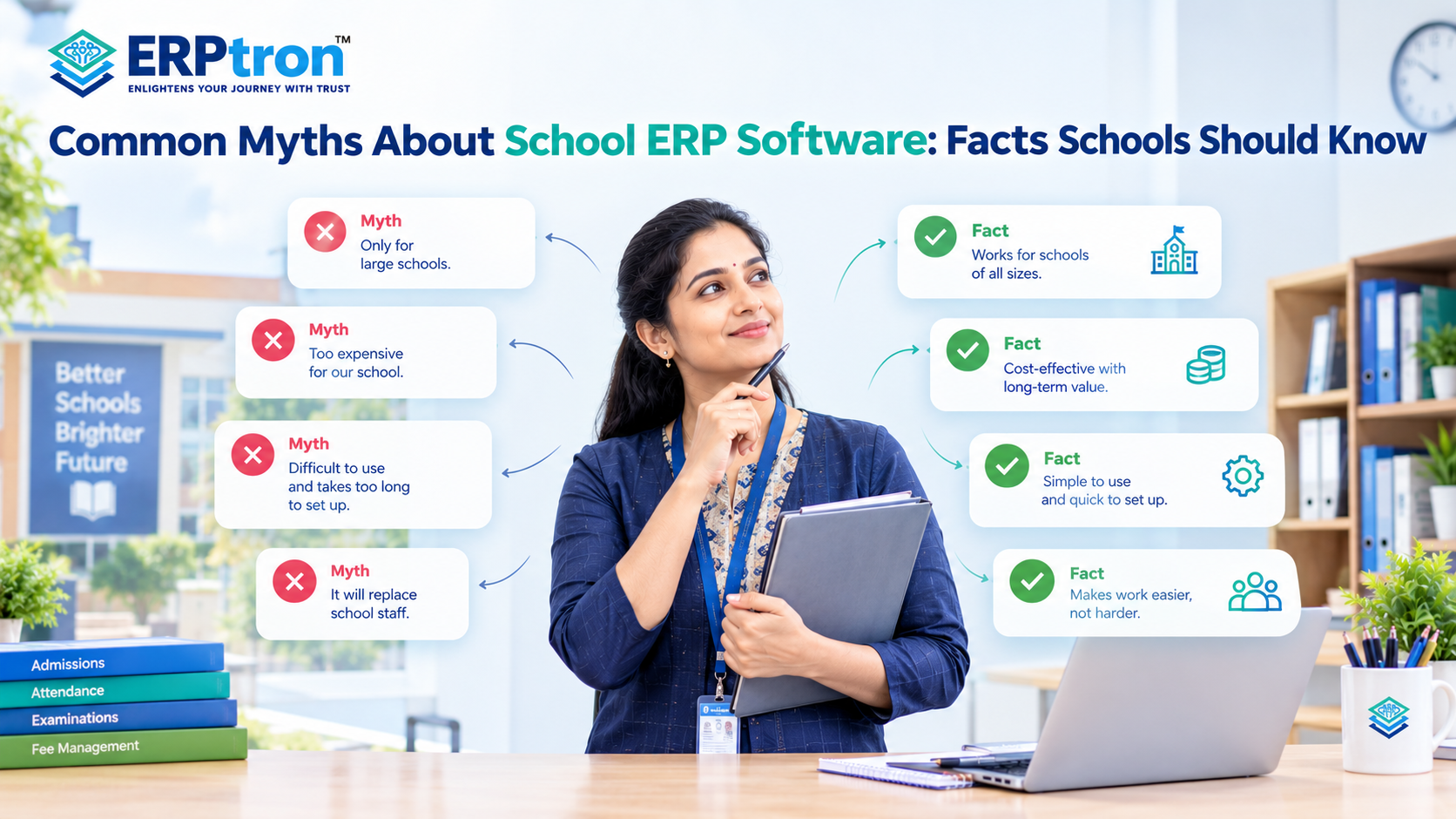
No. Every school has different needs. The decision depends on the school’s size, number of students, budget, daily processes, and plans.
2. What problems can School ERP solve?
A School ERP can help with common problems such as duplicate data entry, manual fee tracking, attendance management, admission management, reporting, and communication.
3. Is School ERP suitable for small schools?
Yes. Small schools can also use ERP software, but they may not need every module. They can start with basic features and add more modules as the school grows.
4. How much does School ERP software cost?
The cost depends on factors such as the number of students, modules, users, integrations, implementation, and support. Schools should look at the total cost instead of comparing only the software price.
5. What should schools check before buying ERP software?
Schools should check the software’s features, ease of use, integration, security, scalability, mobile access, support, training, data migration, customization, and total cost.